(View the original post here.)
A brief summary
On 29 Aug 2021, it was announced that Yale-NUS will merge with NUS’ University Scholars Programme (USP) to form a new college. The New College will open by August 2022.
How did this happen?
- This was a unilateral decision made by NUS – the idea was first brought up to MOE by NUS President Prof. Tan Eng Chye in June 2021.
- YNC President Prof. Tan Tai Yong shared that the decision had already been made by NUS, by the time it reached both Yale and Yale-NUS.
Why?
- According to Prof. Tan Eng Chye, this will allow NUS to “deliver flexible, interdisciplinary education more accessibly, and at greater scale“.
Firstly: On “merger” vs “closure”
NUS has called this new development a “merger”. Mitchell Palmer, a first year undergraduate at YNC, explains why it’s not:
Yale-NUS College is a unique university-within-an-university. Though part of NUS for legal purposes, it has all of the trappings of an independent Liberal Arts College: It has small class sizes and students are only taught by professors. It has its own independent faculty, its own course structure, its own honours system, and even issues what are effectively its own degrees.
The New College will have none of that. Though some faculty would work at the New College, most of the courses students would take would be at NUS. That means, whereas Yale-NUS has its own economics, literature, chemistry, and physics (etc.) departments separate from those of the University, the New College will not. They will still attend the type of courses common at large research universities around the world, taught by TAs and with 500-person lectures. Thus two-thirds of their classes will be no different to those of NUS itself. …. Yes, it will have a common curriculum and students will live on campus for some (but not all, unlike at Yale-NUS) of their degree tenure: But housing and a Common Curriculum do not a Liberal Arts College make.
These excerpts have been shortened for brevity. The full piece can be read at mitchellpalmer.github.io.
What are the reasons behind the closure?
Was it Yale who initiated this?
No, far from it actually. Yale President Peter Salovey said in a statement: “Given our great pride in Yale-NUS College and our love and respect for the faculty, students, and staff who compose its extraordinary community, we would have liked nothing better than to continue its development. “
Was academic / political freedom a consideration?
According to Pericles Lewis, Vice-President for Global Strategy at Yale and Yale-NUS’s founding president, academic freedom was not a factor. (Nevertheless, speculation is rife given that YNC is known for being a more progressive space in Singapore.)
What about financial considerations?
This is a possibility. Associate Professor Shaffique Adam wrote on Twitter that expenditure at YNC far exceeded tuition income, and that endowment fell short of projections. In short, “the financial model was not sustainable”.
Why is this such a big deal?
To those who don’t understand all the grief and outrage, consider first how the YNC community must be feeling, to have suddenly received this piece of news with ZERO prior warning. (Not just students, but faculty and staff members too.) The changes have direct impacts on their life trajectories — daily school life, education, employment, communities…
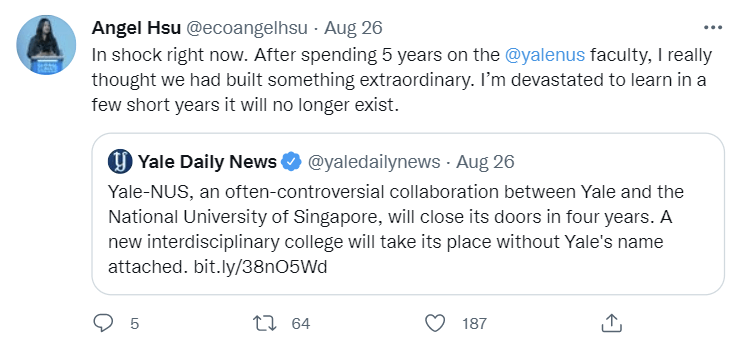

The impacts of the closure go far beyond the school gates.
I think what YNC had was space, support (institutional, academic, peers), and an ecosystem. From which ideas could flourish. It was an effervescence that led to changing of school policies that Green Monday (that became Green Wed and Fri). And also SG Climate Rally.
Neo Xiangyun, YNC alumni
The fact that YNC students themselves concerned about various social causes were talking about each other, contributed to the wider societal narrative out there about intersectionality.
Personally also very proud to have been part of the first Singaporean non-fiction environmental anthology about life of humans and nonhumans and our relationships with each other!! The impacts of art, culture etc are always gonna be immeasurable. It’s a mosaic here and there that add up, that echo each other, influence and then suddenly manifests in a 2000 strong die-in at Hong Lim Park. Then we realise there is momentum. And resonance and physical weight behind words/ideas.
Beyond the closure itself, we need to raise more questions about how the decision was made, and the scary power dynamics at play. There is a broader issue at stake here: a culture whereby decisions are made above communities, rather than with them.
My initial reaction to hearing the announcements first hand was feeling numb: this is Singapore, all over again. The erasure of identity, destruction of community, the unilateral decision-making without consultation, the processes which lack care and support for those who suffer the most and gain the least from such decisions, a blind pursuit for more and for scale, the loss of space, culture and spirit. Numb, because it keeps happening again. More than 5 years now working across three sites and communities being forced to relocate and resettle. The regular news cycle of something (buildings) being demolished, something (green spaces) being cleared, something (thriving human spaces) being forced to alter or subject to being taken away. Scary, because nothing seems to be able to stop it from happening again. Because we don’t quite ask if there is a pattern here. Because across different interests and communities, there isn’t enough conversations about how these are all fundamentally the same things happening in different ways. Most scarily, knowing how many of us grow into adulthood and into different roles of power and influence in all kinds of different spheres (no matter where or size), with a certain numbness and acceptance that this is the norm, this is inevitable, and perhaps learning to accept this is the way to survive.
Lim Jingzhou, YNC alumni
Read his original post here
To be clear… is YNC perfect? No, far from it.
Is it the only institution in Singapore teaching controversial subjects? No. A number of students and professors from other schools have spoken out about this, including former Nominated Member of Parliament (NMP) Daniel Goh and NUS alumni Rachel Bok.
And is it the only space for student-led activism and organising in Singapore? No, definitely not.
But it’s still a space for alternative voices and critical discourse, in a country with already SO few of such spaces. Yale-NUS has served as an incredible platform for so many youths I know to tackle difficult conversations, challenge narratives, and fight for the things they believe in.
The loss of this institution signals even bigger losses for our society as a whole – particularly for advocacy, organising, and the broader civil society space. Which is why even for those of us not affiliated to the institutions involved, we need to pay attention.
Hold space for your friends who are grieving. Read, listen; try to understand their sadness, outrage and frustration. Show that you care; that you believe in what they’ve created this past decade.
And perhaps more crucially, support them in whatever ways you can, as they continue the work of culture-building and change-making in this next new phase. Because what they’ve built in Yale-NUS is worth preserving — for them AND for Singapore.
 Kate Yeo
Leave a comment